Monday, February 8, 2016

What influences coral survival through an extreme bleaching event?

By Sean McNally and Jessica Carilli, UMass Boston

Reefscape of diverse corals on the south side of Kiritimati (pronounced "Christmas") Island. 
Hard corals are animals that host symbiotic algae in their tissues called zooxanthellae. Corals obtain most of their food from algal photosynthesis – the algae make sugars from carbon dioxide, water, and sunlight, and some of this gets leaked to the coral hosts, feeding them. Despite this effective relationship in which a heterotrophic animal benefits from photosynthesis of microscopic algae, additional nutrients such as nitrogen and phosphorus are necessary for plant and animal growth, and must be attained by the coral ingesting zooplankton, particulate matter, or dissolved compounds. In a perfect system the corals provide shelter and nutrients like nitrogen and phosphorus to the algae, and the algae provide the corals with sufficient food to grow. This symbiotic relationship allows corals to create hard skeletons. Over long periods of time, corals can grow into reefs large enough to view from space. However, chronic or episodic stress can push this relationship out of whack, leading to the coral host expelling its symbionts and becoming “bleached.”
This white Acroporid coral colony is completely 
bleached, with its white skeleton
now visible through clear tissues. If
it has enough fat stores or is able to
feed on zooplankton, it might survive this
bleaching episode. 


The main environmental stressor that causes large-scale coral bleaching is increased sea surface temperature. But why do corals bleach? That’s an important question. Bleaching is not as straightforward as it might seem, particularly because different colonies of corals of the same species—even ones that live right next to each other—might have very different responses to the same stress.

First, let’s get a little technical: The current theory is that increased light and temperatures cause direct damage to the photosystem II portion of the photosynthetic pathway in coral symbionts. Excess oxygen radicals are produced that build up and eventually become toxic to the coral host. This “oxidative stress” results in the degradation and eventual expulsion of symbionts from host tissue. Interestingly, corals can host different types of zooxanthellae, and these can differ in their thermal and light tolerance. One theory suggests that stressed corals bleach to swap out less tolerant for more tolerant symbionts.

However, once symbionts are expelled, corals can starve or become more susceptible to disease. Corals that bleach and survive might either eat enough zooplankton, or live off stored-up fat, to survive these lean times. Increasing seawater temperatures associated with global climate change are likely to result in more frequent bleaching events.

We are joining the Cobb and Baum labs on Kiritimati Island in March to help answer the questions: 
What factors influence coral survival through an extreme bleaching event? 
Are there characteristics we can identify that might predict coral survival in future events?  Understanding why some corals resist or better recover from bleaching is crucial to better protecting reefs into the future.

Wednesday, February 3, 2016

Going "All In" for Science

by Kim Cobb

This spring, my lab will mortgage our scientific future to collect a once-in-a-lifetime dataset on the heels of the largest El Niño event on record. We'll document the effects of this climate extreme on coral reefs in the middle of the Pacific Ocean, where peak El Nino-related coral bleaching and mortality took place. Or at least that's what we infer from the exceedingly warm temperatures relayed back to our screens from buoys near our research site.
Map of current coral bleaching alert, from NOAA's Coral Reef Watch, showing Christmas Island (center of blue circle) in Alert Level 2 status ("mortality likely", according to the legend on the web-page). 
In order to make this field expedition happen, myself and my collaborators are pooling what scant discretionary funding we can find into a collective pot of sorts. We hope that it will go far enough to ensure the participation of the key team members - each of whom brings irreplaceable expertise to the project.

You see, we've been working together as an interdisciplinary team of physical oceanographers (ocean circulation gurus), coral ecologists, climate modelers, and geochemists since August 2014, thanks to two RAPID grants from the National Science Foundation. We got one year of funding to study the effects of the 2014-2015 El Nino event on coral reefs at my long-term research site, Christmas Island. But wait, you're saying to yourself. There wasn't a large El Nino event in 2014/2015, was there?

Before (or while) you have a good chuckle at our expense, consider the following. For one, we were not alone in thinking that a major El Nino event was in the making during spring of 2014, when we submitted our proposals. And more importantly, our datasets ended up providing an incredibly rich dataset to document conditions before and during the birth of this year's record El Niño. In a way, we couldn't have planned it better - what good are experimental data on this El Nino without an appropriate baseline?

We approached the NSF with precisely this argument in early fall, 2015, as our RAPID funding was expiring, to seek an extension that would enable us to study what was shaping up to be a mega-El Niño. We were denied, on the grounds that it was time to let other research groups have a crack at an El Niño RAPID this winter. Fair enough, even though I find it scientifically short-sighted (totally unbiased opinion). Here is a list of El Niño RAPID awards made this winter.

Running on fumes, funding-wise, we sent a skeleton crew to Christmas Island in the November, 2015 to make some early observations of coral bleaching and mortality levels (summarized here). We also serviced environmental loggers that have been collecting data continuously from August 2014 until now, took hundreds of seawater and rainfall samples for geochemical analyses, and tagged coral colonies ranging from minor to 100% bleached, for follow-up tissue sampling, drilling, and geochemical analyses.
 
A partially bleached Porites colony tagged for future
analyses by our team in November, 2015.
It’s been over three months of scorching ocean temperatures since our last trip, and we know that a large majority of the island’s reefs are bleached, if not completely dead. But we won’t know the full extent of the damage unless we can get back out there. And this time, a skeleton screw will not suffice:  we need to systematically survey the reefs at Christmas, from the leeward to the windward side, from shallow to deep. We need to deploy multiple boats per day, filled with teams of science divers, to have a prayer of collecting the comprehensive data and samples we need to answer the big questions about El Nino, climate change, and coral reefs. The resulting data and samples will be analyzed from the perspective of coral genomics & physiology, trace metal and isotopic geochemistry, ocean mixing and circulation, and coral reef ecology. None of these investigations will be conducted in isolation, but rather in our team’s collaborative playground, pushing questions at the intersections between our disciplinary expertise.

So how can we afford to launch a major expedition with no funding? It’s simple really. We cannot afford not to. We could wait 20 more years for an event of this magnitude to open the door to our most ambitious scientific questions – questions that we have been pursuing as independent scientists for our entire careers. By putting our hearts, our heads, and our labs’ very modest pocketbooks on the line this spring, we are absolutely certain that we will deliver some fundamental new insights about the fate of coral reefs under climate change, and the role of climate change in fueling monster El Nino events.

What is happening to the corals reef at Christmas Island this winter is a tragedy. But the bigger tragedy would be to let it go completely undocumented, thus robbing future generations of ecologists and climate scientists of the data and samples they need to study this climate extreme, together with its long-term effects and implications. 

So, are you with us? If so, please consider supporting our spring expedition here. Any contribution brings a smile to our face and a bounce to our step. Thanks for valuing science.


Tuesday, November 10, 2015

Cooking corals on Christmas Island

Bay of Wrecks, windward side, 30ft depth. Photo of newly-dead, algae-covered Acropora coral (brown-green fuzzy plates), bleached and partially-bleached Porites (white and yellow-white nubbly massive-type corals), bleached Montipora (white fungus-looking coral in lower left of photo), and partially-bleached Pocillopora (white-tipped branching corals). Photo by Pamela Grothe.
by Kim Cobb

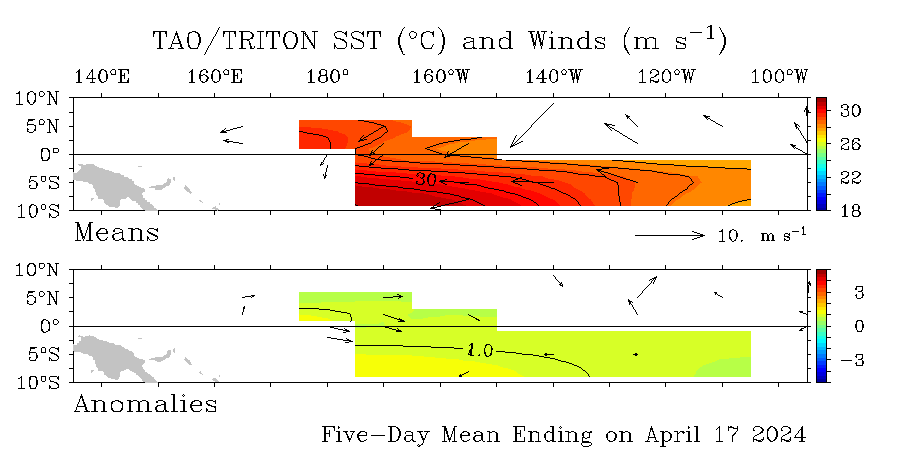
On this remote island in the middle of the Pacific Ocean, corals are being put to the test of their lives as water temperatures soar to a staggering 31C (88F). The current El Niño event is responsible for the large-scale warming across the equatorial Pacific, but water temperatures have been above the threshold for coral bleaching at this site for months now. Worst of all, waters will remain far above average for the next 1-2 months, before returning to near-normal values by spring 2016.  

The last time water temperatures reached such levels was during the 1997/98 El Niño event – the largest El Niño event on record. Presumably the reef at Christmas Island was devastated by widespread bleaching and mortality, but nobody was around to document the effects. As it happens, I snorkeled the reefs at Christmas during November 1997 as a baby graduate student, but didn’t think to take photos or make any systematic observations at the time.

Over the last week, our field team has been systematically documenting the status of the many different types of coral reefs on Christmas Island. In close collaboration with Dr. Julia Baum (U. Victoria) – a marine ecologist by training – we have taken hundreds of photos along preset transects that she and her students have been surveying for the last 7 years. Such baseline data are critical to understanding how this off-scale thermal stress event has impacted the reef. And up until July, 2015, her field teams had documented thriving reef communities all around Christmas Island. This July, they observed the beginnings of the current bleaching event, with some species showing widespread bleaching but little mortality.

This time, the underwater damage is jaw-dropping. It is hard to describe the gut punch that I took when I first witnessed the devastation on the remote windward reefs. Here, entire species of coral, such as Acropora, were already coated in brown-green algae, pushed far beyond the point of bleaching many weeks ago. Others, such as Favia, were 100% bleached, with some algae-coated colonies having lost their months-long battle against the warm waters. Consistently, we observed Porites and Pocillopora in various states of bleaching. For Pocillopora, every colony showed bleaching at the tips of its stocky branches, but very few were completely bleached. While some Porites colonies were completely bleached, a Porites colony only a few meters away may have only exhibited mild paling. We did not see any dead Porites colonies – at least not yet. This genus is particularly important to my lab’s work, as we use Porites colonies to reconstruct El Niño events for the last 7,000 years, calibrating our reconstructions with colonies growing on the reef today. Ecologically, it is one of the more resistant species to bleaching, so its resilience to the current thermal stress event is a key benchmark of reef health. I would estimate total coral bleaching and/or death at 50-90% (very site-dependent).

We will be returning to Christmas Island in March 2016 with the Baum team, at the tail end of the current El Niño event, to document the maximum extent of bleaching and mortality. Judging by how much the reefs have deteriorated from July to November, the next four months may well witness near-100% mortality for most of the Christmas Island coral reefs.

Our latest field observations confirm our fears – that the current bleaching event will reshape the reefs at Christmas Island for years to come. Monster El Niño events are nothing new to Christmas, as recorded in the geochemical variations of centuries-old coral skeletons from my lab’s work, but the rapid succession of very strong El Niño events in the last decades stands out against the backdrop of natural variability in our records. For the reefs at Christmas Island, the 2015/2016 El Niño event may be a tiding of things to come under continued anthropogenic climate change. If so, then the current event represents a golden opportunity to study if and how this reef is fundamentally (and possibly permanently) altered under acute thermal stress. After all, while we cannot stop the ravaging effects of the current El Niño on coral reef ecosystems across the Pacific, we can certainly learn some key lessons from it. It isn’t far-fetched to think that one day, such lessons may provide the blueprint for engineering the resilience of corals reefs to climate change.

Below are some of the photos from the last week's expedition. UPDATE:  A special thanks to Danielle Claar (U. Victoria) for helping to identify the species in these photos.
South Side, 30ft depth. This was the healthiest site we saw. 100% bleached Hydophora microcons beginning to die (brown cap on pure white, spherical colonies in foreground), nearly 100% bleached Porites (white nubby mass in center of image), and partially-bleached Porites (pale yellow nubby mass in lower left of photo), and severely bleached Pocillopora (white-tipped branching coral to the far right of photo). Photo by Kim Cobb.

South Side, 30ft depth. 100% bleached and some dying Hydnophora, Favia, and Favites corals (white, round colonies w/ brown caps), partially-bleached and some dead Pocillopora (white-tipped branching corals), 100% bleached Montipora (white fungus-like fans), and dead Favia corals (round, brown, smallish corals - hard to see here). Photo by Kim Cobb.

Bay of Wrecks, 30ft depth. Photo shows dead Acropora colonies (brown-green fuzzy plates in left half of photo), 100% bleached Porites colony (large white nubbly coral), and numerous partially bleached Pocillopora colonies (white-tipped branching corals). Photo by Pamela Grothe.


Wednesday, November 4, 2015

Into the El Niño sauna


by Kim Cobb

I’ve been waiting 18 years for this moment.

You see, I study the El Niño-Southern Oscillation (some would say I’m obsessed with it), and this is the largest El Niño event since 1997/98, which itself was the largest El Niño on record. During that event, I was a beginning graduate student on a large research cruise to Christmas Island. I had no context for the conditions I was witnessing at the time – the white corals, the huge swells on the leeward side, the constant rain. Nobody on the cruise fully grasped the magnitude of the event that would peak that very month.

Fast-forward 18 years, and I am leading the first of several field expeditions designed to document the effects of this massive El Niño event on the coral reefs I’ve been studying for my entire career. The event itself will be gone in the blink of an eye, but its effects on coral reef ecosystems will likely last a decade or more.

At 2N, 157W, Christmas Island lies at the epicenter of the current El Niño event. NOAA has sounded the alarm on a global coral bleaching event that is currently underway, and Christmas Island has been under an Alert Level 2 (indicative of “Mortality Likely”) for the last three months (Figure 1). With ocean temperatures projected to remain warm over the next 1-2 months before cooling into the spring, most of the corals here will likely bleach. When corals lose their colorful, symbiotic algae, they lose a critical source of energy and become much more vulnerable to disease and infection. If bleaching lasts for more than a few months, corals are unlikely to survive the episode. In 1997/98, I witnessed widespread bleaching and mortality – although nobody was around to do an official survey. And over the last 18 years, I’ve watched the reefs recover, slowly but steadily.  
Figure 1. Map of coral bleaching projections for the last week, from NOAA Coral Reef Watch, showing a high likelihood for bleaching at Christmas Island.
In my lab, we use geochemical variations locked in coral skeletons from Christmas Island to reconstruct a history of El Niño-Southern Oscillation (ENSO) variability over the last centuries to millennia. Our lab’s data show that recent ENSO variability is significantly stronger than ENSO variability over the last 7,000 years, indicating that greenhouse gases may be driving an intensification in ENSO extremes (see related publication here). But what happens when the archive I rely on to study past El Niño events is threatened by a very strong El Niño event? I don’t know, but this winter, I intend to find out.

Ever since spring 2014, I’ve been waiting for the fledgling El Niño event to take shape. In late August of this year, after a decisive push from the atmosphere in the right direction, the breath-holding gave way to a flurry of preparations for the upcoming field season. Over the course of three planned expeditions, my lab’s resources, and those of my collaborators, will be stretched to the very limit (and beyond, in some cases).

Our mission for the current trip is multi-fold, and incredibly ambitious.

Our top priority is to service and/or install a wide variety of environmental logging devices, including a high-end weather station, as well as ocean temperature and salinity loggers, some of which were installed in Summer 2014. We will collect hundreds of rainwater and seawater samples to document how this event has changed the geochemical and isotopic properties of the environmental waters - changes that the corals record in their skeletons and that we rely on to document past El Niño events. With this trove of data, we hope to quantify how the physical and chemical environment changed before, during, and after the event.

Our second objective is to document the health of the coral reefs on Christmas Island by systematically photographing transects of corals previously photographed by our collaborator Julia Baum and her students on previous expeditions to the island. When her team was here in July 2015, her graduate student Danielle Claar photographed a variety of bleached corals, estimating total bleaching at roughly 30% (Figure 2). We expect much more extensive bleaching this time around, as ocean temperatures have only increased since that time.
A bleaching Acropora colony in upper left, along with fully bleached Pocillopora colonies, in July 2015. Photo taken by Danielle Claar.
The field team includes my new NOAA Postdoctoral Fellow Alyssa Atwood, my graduate student Pamela Grothe (a seasoned Christmas Island expeditioner), and long-time undergraduate researcher Shellby Miller. Yes, this is an all-female research team!
From left:  Pamela Grothe, Kim Cobb, Alyssa Atwood, and Shellby Miller.
Stay tuned for updates from the field (internet permitting - I blame the unusually slow internet on El Niño, of course).